
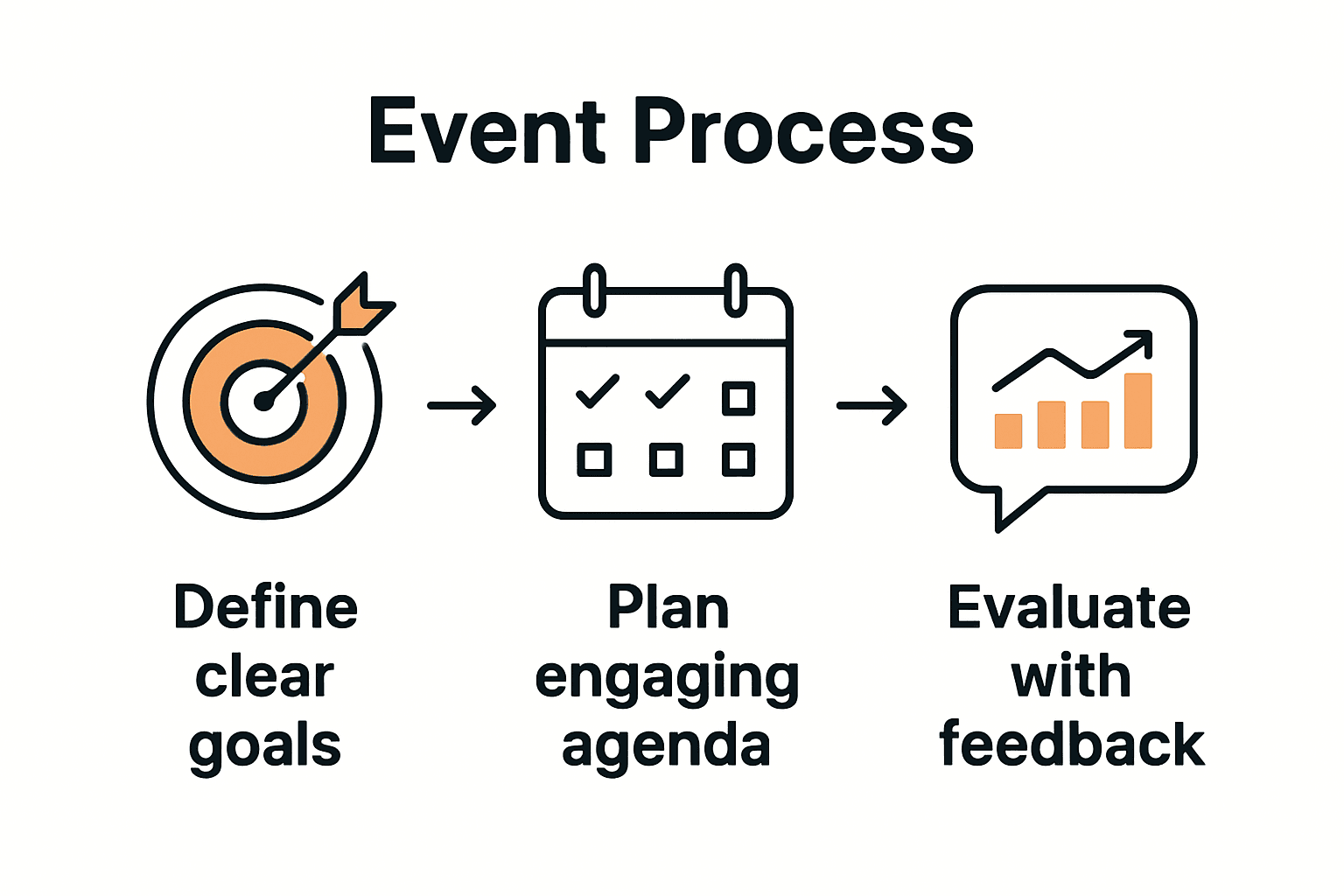
Planning a team building event that creates lasting impact requires more than booking a venue and picking a few activities. The most successful events follow a disciplined sequence — clear objectives, the right planning team, a deep understanding of attendees, a venue that fits the goals, a well-paced agenda, and a structured way to evaluate results. This step-by-step guide walks through the entire arc, drawing on best practices from leading event education programs and our own experience producing corporate events.
June 2026 Update
If you are working through these steps for a summer event, factor the season into your timeline at Step 4 (venue selection): peak-season demand means the best venues and activity slots get reserved early, so move from objectives to venue shortlisting faster than you would off-season. A useful rule of thumb for mid-2026: give yourself at least three to six months of lead time for a standard program, and more for larger groups or anything requiring travel and accommodation. Teams planning for the autumn have an advantage — September and October offer easier availability and better value while keeping the weather window open for outdoor activities. None of this changes the framework below; it simply means Steps 1 through 4 should happen sooner in the calendar when you are competing for peak-season capacity.
Table of Contents
- Step 1: Define Objectives And Desired Outcomes
- Step 2: Assemble The Planning Team And Allocate Roles
- Step 3: Identify Attendee Profiles And Special Requirements
- Step 4: Select The Optimal Venue And Experience
- Step 5: Design A Detailed Agenda And Activities
- Step 6: Evaluate Event Success And Gather Feedback
Quick Summary
| Essential Insight | Detailed Explanation |
|---|---|
| 1. Define specific event goals | Establish clear, measurable objectives for the event to drive focus on desired outcomes and shape the agenda. |
| 2. Assemble a diverse planning team | Select team members with varied skills and assign roles according to individual strengths to enhance collaboration and efficiency. |
| 3. Understand attendee needs | Gather demographic and accessibility information to ensure the event is inclusive and meets all participants’ requirements. |
| 4. Choose the right venue | Evaluate potential venues based on accessibility, facilities, and alignment with event objectives to create a supportive environment. |
| 5. Collect comprehensive feedback | Implement a robust evaluation process post-event to measure impact and guide future improvements based on participant insights. |
Step 1: Define objectives and desired outcomes {#step-1-define-objectives-and-desired-outcomes}
Defining clear objectives is the critical first step in planning a successful team building event. According to Kent State University, effective event planning starts by asking strategic questions about purpose and intended impact. Without well-defined goals, even the most creative activities risk falling flat.
To craft meaningful objectives, break down your goals into specific, measurable targets. Ask yourself: What do we want participants to learn, experience, or achieve? Will this event improve communication, boost morale, or solve specific team challenges? University of California Agriculture and Natural Resources recommends starting with a written statement of desired outcomes and using it as the touchstone for every subsequent decision.
Pro tip: Be precise and realistic. Instead of vague goals like “improve teamwork,” specify tangible targets such as “increase cross-department collaboration by creating three new interdepartmental project teams.” This approach transforms abstract intentions into concrete, actionable outcomes that you can actually measure.
Once you’ve crystallized your objectives, you’re ready to move forward with detailed event planning strategies that align with your team’s specific needs and organizational goals.
Step 2: Assemble the planning team and allocate roles {#step-2-assemble-the-planning-team-and-allocate-roles}
Building an effective planning team is the foundation of successful event execution. According to the World Association of Girl Guides and Girl Scouts, strategic role allocation is crucial for comprehensive event management — every responsibility needs an owner.
Start by identifying key team members who bring diverse skills and perspectives. Typical roles include a Project Manager to oversee the entire process, a Communications Manager to handle internal and external messaging, a Logistics Manager to coordinate practical details, and a Budget Coordinator to track spending. On smaller events these can collapse into fewer hats, but the responsibilities themselves should not disappear.
Pro tip: When assigning roles, consider individual strengths and interests. Match team members to responsibilities where they can shine and feel motivated. A person who loves spreadsheets might be perfect for budget tracking, while a creative communicator could excel in designing event materials.
Once your team is assembled and roles are defined, you are ready to move into detailed planning and strategy development.

Step 3: Identify attendee profiles and special requirements {#step-3-identify-attendee-profiles-and-special-requirements}
Understanding your audience is critical to creating a memorable and inclusive experience. Oregon State University emphasizes the importance of identifying your target population to ensure the event truly resonates.
Begin by gathering comprehensive information about your attendees. Consider demographic factors such as job roles, departments, professional backgrounds, and the diversity within your group. Les Roches Global Hospitality Education highlights how attendee research shapes everything from venue choice to catering and activity design.
Pro tip: Create a comprehensive attendee survey before the event to collect detailed information. Ask specific questions about dietary needs, mobility challenges, communication preferences, and any special accommodations that will help you design a truly inclusive and engaging experience.
With a clear understanding of your attendee profiles, you can move forward to designing tailored activities and experiences that will resonate with your specific group.
Step 4: Select the optimal venue and experience {#step-4-select-the-optimal-venue-and-experience}
Choosing the right venue is a pivotal decision that can make or break your team building event. Les Roches Global Hospitality Education emphasizes the critical factors of accessibility, on-site facilities, ambiance, and overall alignment with your event’s objectives.
Begin by creating a comprehensive venue checklist that goes beyond basic requirements. The World Association of Girl Guides and Girl Scouts recommends evaluating locations based on capacity, specific facilities, potential restrictions, and how well the space supports your team building goals. Consider transport access, parking, on-site catering options, breakout space, and any technical infrastructure your activities will require.
Pro tip: Always conduct an in-person site visit before making a final decision. Pictures and descriptions can be deceiving, and a physical walkthrough will help you understand the space’s true potential and any challenges that might not be immediately apparent.
Once you’ve selected the venue, you’re ready to move forward with designing specific activities and experiences that will transform your team building event from ordinary to extraordinary.
Step 5: Design a detailed agenda and activities {#step-5-design-a-detailed-agenda-and-activities}
Creating a well-structured agenda is the blueprint for a successful team building event. University of California Agriculture and Natural Resources emphasizes the importance of defining clear desired outcomes and assigning each activity a deliberate role within the day.
Columbia University’s School of Professional Studies recommends developing a comprehensive timeline that anticipates potential challenges and creates solutions in advance. Start by mapping out each activity with precise durations, considering the energy flow of the day. Alternate between high-intensity collaborative challenges and reflective lower-intensity moments so participants stay engaged without burning out.
Pro tip: Build in flexible buffer time between activities. No matter how meticulously you plan, unexpected moments will arise — having breathing room prevents stress and allows spontaneous team dynamics to naturally emerge.
With your detailed agenda in hand, you are now prepared to move into the critical execution phase of your team building event.
Step 6: Evaluate event success and gather feedback {#step-6-evaluate-event-success-and-gather-feedback}
Brandeis University’s Department of Student Engagement emphasizes the critical importance of setting specific, measurable objectives and systematically evaluating outcomes to understand whether your event truly delivered on its goals.
Boston University’s Human Resources department recommends developing a comprehensive feedback mechanism that goes beyond simple satisfaction surveys. Create a multi-dimensional evaluation that captures both immediate reactions and longer-term shifts in team behavior — engagement, communication patterns, and follow-through on collaborative commitments.
Pro tip: Make your feedback collection process as engaging as the event itself. Use interactive survey tools, create short video feedback prompts, or host a casual debrief session that allows participants to share their honest perspectives in a comfortable environment.
With a thorough evaluation complete, you now have valuable insights to refine future team building strategies and demonstrate the meaningful impact of your carefully crafted event.
Transform Your Team Building Vision Into Reality with UPE
Planning team building events step by step reveals common challenges: defining clear objectives, selecting the right venue, and designing activities that truly engage every participant. The pain of balancing logistical detail while aiming for measurable outcomes can feel overwhelming. Our experience producing business events and exclusive events shows that disciplined planning is what separates a memorable day from a forgotten one.
Imagine a seamless experience where every detail — from attendee needs to innovative activities — is expertly managed, freeing you to focus on meaningful team connection and success. At UPE we combine creativity, professionalism, and a deep understanding of group dynamics to deliver events that align with your strategic goals.
Ready to elevate your team building event beyond expectations? Get in touch with our team and start crafting an unforgettable experience that delivers measurable impact and lasting team engagement.
Frequently Asked Questions
What are the first steps to plan a successful team building event?
Defining clear objectives is the critical first step. Start by breaking down your goals into specific, measurable targets — for example, increasing cross-departmental collaboration by forming new project teams — so every later decision has a yardstick to measure against.
How do I assemble a planning team for my event?
Begin by identifying key team members with diverse skills and perspectives. Assign roles such as Project Manager, Logistics Manager, and Budget Coordinator based on individual strengths to ensure efficient event planning.
What should I consider when identifying attendee profiles and special requirements?
Gather comprehensive information about your attendees, including job roles, accessibility needs, and dietary restrictions. Create a detailed attendee survey to collect this information before the event, ensuring an inclusive experience for everyone.
How can I select the right venue for my team building event?
Choose a venue that aligns with your event objectives and can accommodate your group’s needs. Conduct an in-person site visit to assess the layout, facilities, and overall ambiance to ensure the space supports your team building goals.
What should be included in a detailed agenda for the event?
Your agenda should outline each activity with precise durations while connecting them to your original objectives. Include a mix of high-energy challenges and collaborative moments, and leave flexible buffer time between activities to maintain engagement.
How do I evaluate the success of my team building event?
Develop a comprehensive feedback mechanism that captures both quantitative metrics and qualitative insights. Collect feedback immediately after the event and follow up with participants within a few weeks to measure shifts in team dynamics and communication.
Recommended reading
- What Is Corporate Event Planning? — a foundational overview of corporate event planning
- Corporate Event Management: Complete Overview — the broader discipline that team building events sit inside
- More articles on the UPE blog